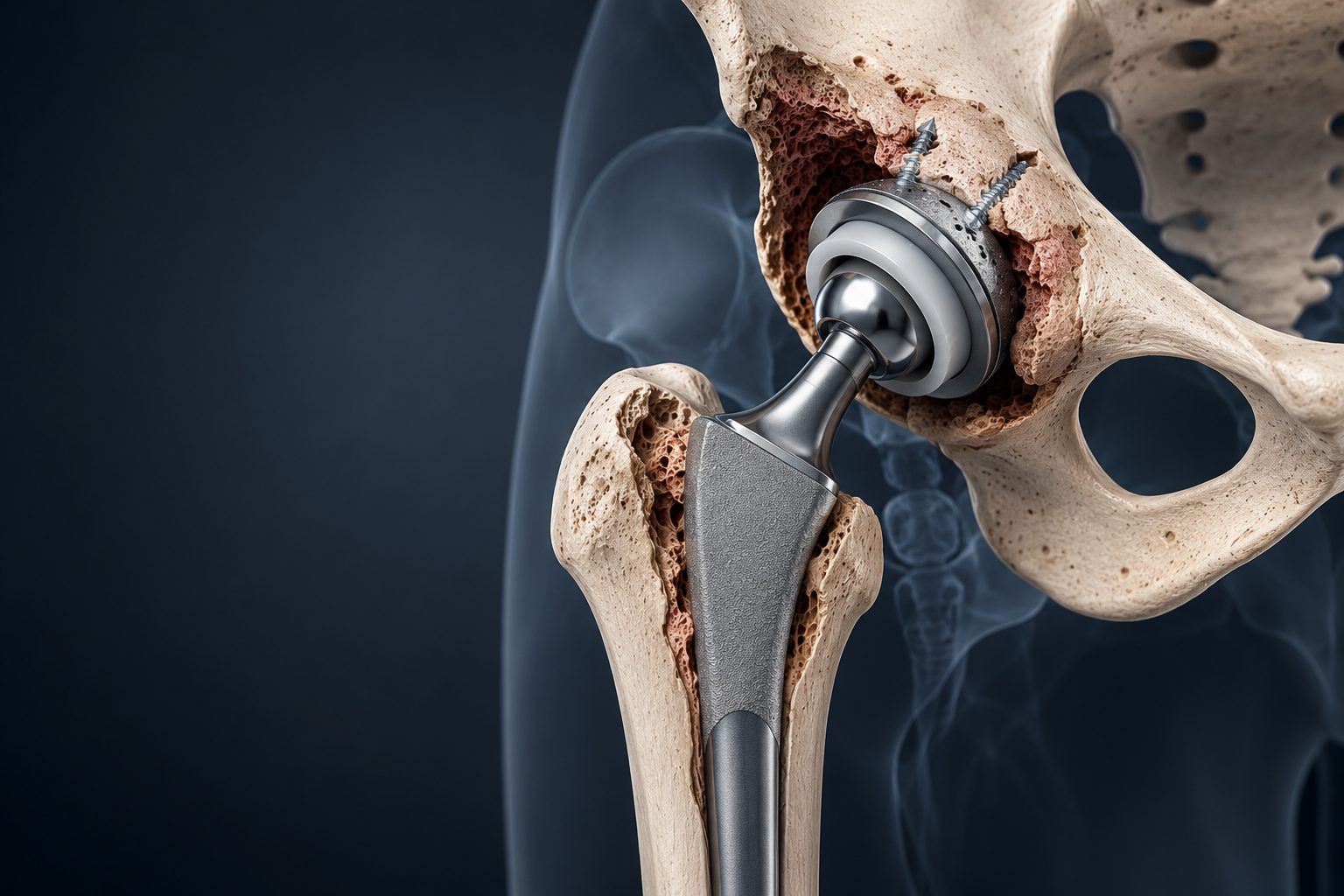
If pain has returned after your joint replacement, walking has become more difficult, you feel instability in the joint, or your doctor has recommended another operation, the first step is always to determine the cause of the problem.
Revision arthroplasty is often more complex than the original operation and requires detailed preoperative planning.
Why an implant may need a repeat operation
Modern joint replacement can restore joint function for many years, but no artificial construct lasts forever.
A repeat operation may be needed many years after the primary arthroplasty, or much sooner, if a complication develops.
The reasons can vary:
- aseptic loosening of the components
- wear of the implant's parts
- dislocation or instability
- periprosthetic fracture
- significant bone loss
- malpositioning of the components
- mechanical failure of the construct
- infectious complications
- other causes of pain and impaired function after arthroplasty
It is the underlying cause that determines the further treatment approach.
So pain after joint replacement does not automatically mean the entire implant needs to be replaced.
Your implant hurts — does that mean it needs to be replaced?
Not necessarily.
Pain after joint replacement can have many different origins. Not every cause is related to loosening of the components, and not every case requires revision surgery.
Before any decision is made, it's important to answer several questions:
- What exactly is the source of the pain?
- Are the implant components stable?
- Are they correctly positioned?
- Are there signs of infection?
- What is the condition of the bone around the implant?
- Are there other causes of impaired function?
Only after answering these questions can we determine whether surgery is needed and, if so, what its scope should be.
Aseptic loosening
Over time, one or more components of an implant can lose stable fixation to the bone.
A patient may experience pain during walking and weight-bearing, a gradual decline in function, or a sense that the joint no longer works the way it used to.
X-rays and other studies are used to assess the stability of the components and the condition of the surrounding bone.
If clinically significant loosening is confirmed, revision arthroplasty may become necessary.
Wear and bone loss
Over long-term use, an implant's components can gradually wear.
In some cases, wear particles can trigger a reaction in the surrounding tissue and lead to a gradual loss of bone — a process known as osteolysis.
This process can progress for a long time without producing noticeable symptoms.
That's why, many years after joint replacement, periodic X-ray monitoring can be important even when the implant still seems to be functioning well.
Instability and recurrent dislocation
One of the possible complications after hip replacement is dislocation.
A single episode does not always mean revision surgery is needed.
But with recurrent dislocations, the underlying cause must be identified.
It may be related to component positioning, the condition of the soft tissues, joint mechanics, or a combination of several factors.
In this situation, revision surgery should be aimed at eliminating the cause of the instability — not simply reducing the joint one more time.
Periprosthetic fracture
A fracture of the bone near an existing implant is a distinct and complex orthopedic trauma problem.
To choose the right treatment, it's important to determine:
- the location and nature of the fracture
- the stability of the implant components
- the quality of the bone
- the presence of a bone defect
- the patient's overall condition
In some situations, osteosynthesis is possible while keeping a stable implant in place.
In others, one or more components need to be replaced using revision systems.
So a periprosthetic fracture requires treating both the fracture itself and the stability of the implant at the same time.
Infection after joint replacement
Periprosthetic infection is fundamentally different from mechanical loosening.
Choosing the right approach requires confirming or ruling out an infectious process and assessing its nature.
Depending on the clinical situation, treatment may involve different strategies — from surgical debridement with retention of the components in selected cases, to single- or two-stage revision arthroplasty.
With a two-stage strategy, treatment can include:
removal of the infected components ↓ surgical debridement ↓ placement of a temporary spacer ↓ control of the infectious process ↓ repeat joint replacement
The approach is determined individually for each patient.
How revision surgery differs from the primary joint replacement
Revision arthroplasty is often technically more demanding.
The surgeon works with anatomy that has already been altered. Previous surgical approaches, scar tissue, existing components, possible bone loss, and the condition of the soft tissues all have to be taken into account.
During the operation, it may be necessary to:
- remove one or more components
- preserve any components that remain stable and suitable
- remove cement or other materials
- reconstruct bone defects
- restore a stable foundation for the new implant
- use specialized revision components
- restore the limb's length, stability, and biomechanics
Revision surgery is not simply "putting in a new implant instead of the old one." It's a reconstruction of the joint under anatomical conditions that have already changed.
Bone loss
One of the main challenges in complex revision arthroplasty is a shortage of bone.
It can result from loosening, osteolysis, infection, fracture, or previous operations.
Before revision surgery, it's important to assess:
- the location of the defect
- its size
- the quality of the remaining bone
- the options for fixing the new component
Depending on the situation, treatment may involve specialized revision components, bone grafting, augments, and other reconstructive solutions.
In the most complex cases, individual planning and patient-specific implants may be needed.
Does the entire implant need to be replaced?
Not always.
Revision arthroplasty does not necessarily mean replacing every component.
If part of the construct remains stable, correctly positioned, and compatible with the reconstruction plan, it can be preserved in appropriate cases.
In other cases, a full revision is necessary.
The scope of surgery is determined by the reason the primary arthroplasty failed and by the condition of each component individually.
01 — Reviewing the history of the primary operation
When was the joint replacement performed? Which implant was used? How did recovery go? When did the symptoms appear?
If you still have discharge summaries, operative reports, or information about the model of implant used, it's best to bring them to the consultation.
02 — Analyzing X-rays
We assess the position of the components, their stability, the condition of the surrounding bone, and any changes compared with earlier studies.
Older X-rays can be especially useful, as they allow us to see how the problem has developed over time.
03 — Additional tests
Depending on the situation, a CT scan, laboratory tests, and other diagnostic methods may be needed.
A separate priority is to rule out or confirm infection.
04 — Planning the reconstruction
We determine which components need to be replaced, which can be preserved, how large a bone defect needs to be reconstructed, and which implants may be required.
05 — Revision surgery
The planned reconstruction is carried out using the necessary revision components and methods for restoring bone support.
06 — Recovery
Your weight-bearing regimen and rehabilitation depend on the scope of the revision, the condition of the bone, and the stability of the reconstruction.
We start by establishing the cause
Pain after joint replacement is a symptom, not a diagnosis.
Before a repeat operation, it's essential to pinpoint as precisely as possible why the primary arthroplasty stopped providing the expected function.
We plan the revision before we ever reach the operating room
How complex a revision arthroplasty will be is often determined well before the operation begins.
Analyzing X-rays, CT scans, previous surgeries, and the type of implant in place allows us to prepare possible reconstructive solutions in advance.
We preserve what can be preserved
Not every component needs to be automatically removed.
If a component is stable and preserving it fits the overall surgical plan, that can be part of the chosen strategy.
We prepare for bone defects
During a revision, the surgeon must be ready not only to replace the implant, but also to reconstruct the bone support needed to fix it stably.
We combine arthroplasty with reconstructive orthopedics
Especially complex revisions can require methods that go beyond standard primary arthroplasty: bone defect reconstruction, specialized revision systems, and individualized planning.
Have you been told your implant needs to be replaced?
With revision arthroplasty, the decision can be far more complex than it was for the primary operation.
Before another procedure, it's important to understand:
- why the problem occurred
- whether revision is really necessary
- which components need to be replaced
- whether part of the implant can be preserved
- whether there is a bone defect
- whether infection has been ruled out
- what scope of reconstruction may be needed
If a repeat operation has already been proposed to you, a second opinion lets you independently assess the cause of the problem and the possible revision options before making a final decision.
How long does an implant last?
There is no universal timeframe after which an implant must be replaced.
How long it lasts depends on the type of construct, the method of fixation, the load placed on it, the condition of the bone, and many other factors.
The age of the implant on its own is not an indication for revision.
If my implant is 15–20 years old, should it be replaced as a precaution?
Not necessarily.
If it's stable, functioning well, and there's no significant wear or osteolysis, the decision to operate is usually not based on age alone.
At the same time, routine follow-up X-rays can catch changes before significant symptoms appear.
Why did my implant start hurting after several years?
There can be many reasons — from problems directly involving the components to conditions affecting the surrounding tissues or other structures.
That's exactly why diagnosing the cause of the pain is essential before any revision is considered.
Can loosening be seen on a standard X-ray?
In many cases, X-rays provide important information about the condition of the implant and the surrounding bone.
But sometimes additional imaging is needed to clarify the picture.
Can only one component be replaced?
In certain situations — yes.
If the other components are stable, correctly positioned, and compatible with the planned reconstruction, a partial revision can be considered.
What should I do if my implant has dislocated?
The first priority is to restore the correct position of the joint and assess the cause of the dislocation.
Revision is not always needed after a first episode. With recurrent instability, a more detailed workup is required.
Is a second operation more difficult than the first?
Often — yes.
During a revision, the surgeon works with altered anatomy, scar tissue, previously implanted components, and possible bone loss.
That's why preoperative planning becomes especially important.
Can an implant be reinserted after an infection?
In many clinical situations — yes.
But the approach depends on the nature of the infection, the condition of the bone and soft tissues, and the results of the earlier treatment.
Can a third or fourth operation be performed on the same joint?
The number of previous operations, on its own, doesn't determine whether another revision is possible.
What matters more is the condition of the bone and soft tissues, the stability of the construct, the presence of infection, and the options remaining for further reconstruction.
What documents should I bring to the consultation?
It's best to bring:
- your most recent X-rays
- earlier X-rays, if you still have them
- discharge summaries from the primary operation and any subsequent procedures
- information about the implant that was used
- CT and laboratory results, if these have already been done
Even old studies can be very useful, since they help us assess how the situation has changed over time.
Having problems after joint replacement?
Pain, instability, or changes seen on an X-ray don't always mean the entire implant needs to be replaced right away.
The first step is to establish the cause of the problem and assess the condition of the existing components and the surrounding bone.
During a consultation, we can review your previous treatment, X-rays, and other tests, and outline the possible options going forward.
If revision arthroplasty has already been recommended to you, the consultation can also serve as an opportunity to get a second opinion before you go ahead with another operation.